Choosing the right battery can make a major difference in how reliably a vehicle, boat, RV, or trolling motor performs. Starting batteries and deep cycle batteries may look similar, but they are designed for different power demands. Using the wrong type can affect performance, charging, and battery life.
So, what is the difference between a starting battery and a deep cycle battery? A starting battery is built to deliver high current for a short time to start an engine, while a deep cycle battery is designed to provide steady power over longer periods and handle repeated deeper discharges.
What Is the Difference Between a Starting Battery and a Deep Cycle Battery?
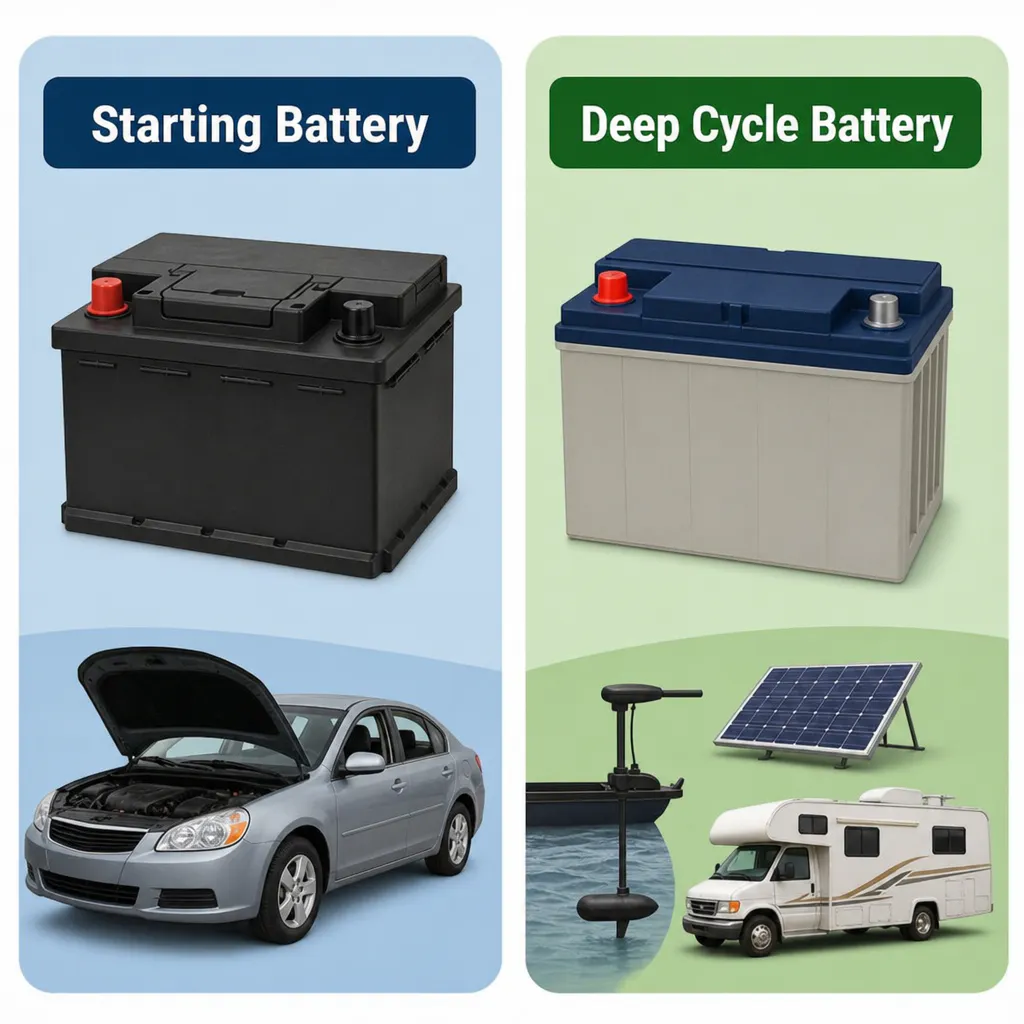
The main difference between a starting battery and a deep cycle battery is how each one delivers energy. A starting battery provides high current for a short time to crank an engine, while a deep cycle battery supplies power more steadily over a longer period.
Starting batteries are generally designed for shallow discharges followed by quick recharging.
Deep cycle batteries are designed to tolerate deeper discharges and repeated cycling, making them better suited for equipment that needs continuous electrical power.
What Is a Starting Battery?
A starting battery is made to crank an engine. It is built for high current, not deep discharge. That makes it a good choice for cars, boats, generators, and other engine-driven gear.
Benefits of Starting Batteries
- High cranking power
- Quick engine starting
- Short-duration current delivery
- Suitable for engine-driven equipment
Common Starting Battery Applications
- Cars and trucks
- Boats
- ATVs
- Generators
- Engine-powered equipment
A starting battery is generally the better choice when the primary requirement is reliable engine starting rather than prolonged electrical operation.
What Is a Deep Cycle Battery?
A deep cycle battery is made to give steady power over a long time. It can also handle repeated discharge and recharge cycles. Unlike a starting battery, it is built for long use, not just a quick burst.
Deep cycle batteries are common in trolling motors, RVs, marine electronics, solar systems, and off-grid power. For many people, the best battery for RV use is a deep cycle battery, since it can run lights, fans, and other loads for longer.
Benefits of Deep Cycle Batteries
- Sustained energy delivery
- Repeated discharge and recharge
- Suitable for continuous electrical loads
- Designed for cycling applications
Common Deep Cycle Battery Applications
- Trolling motors
- RVs and campers
- Solar energy systems
- Marine electronics
- Off-grid power systems
If equipment needs power for hours rather than only the few seconds required to start an engine, a deep cycle battery is generally the more appropriate option.
What About Dual-Purpose Batteries?
A dual-purpose battery mixes features of starting and deep cycle batteries. It can start an engine and also run accessory loads. That makes it useful when you cannot use two separate batteries.
However, a dual-purpose battery is a compromise rather than a perfect replacement for both battery types. If an application has significant starting and continuous-power demands, using separate batteries may provide better performance when the system allows it.
Consider a dual-purpose battery when:
- Engine starting and accessory power are both required
- Installation space is limited
- A single-battery system is preferred
- Moderate cycling is expected
- Separate batteries are impractical
What Is the Difference Between Cranking Power and Deep Cycle Power?
Cranking power is the battery's ability to give a large burst of current quickly. Deep-cycle power is the battery's ability to give steady energy while it is used and charged again.
Feature | Cranking Power | Deep-Cycle Power |
|---|---|---|
Main purpose | Start an engine | Run equipment for a long time |
Power delivery | Very high current for a few seconds | Lower, steady current for hours |
Typical use | Cars, motorcycles, generators | Solar systems, boats, RVs, electric trolling motors |
Discharge | Usually only a small percentage before recharging | Designed to be discharged much further |
Battery plates | Thin, more surface area | Thicker, more durable plates |
Best characteristic | High Cold Cranking Amps (CCA) | High Amp-hour (Ah) capacity and cycle life |
Are Lithium (LiFePO4) Batteries Better Than Lead-Acid for Starting & Deep Cycle Applications?
Lithium (LiFePO4) is vastly superior to lead-acid for deep cycle applications, but lead-acid remains the practical choice for standard engine starting.
Understanding where each chemistry excels reveals key differences in how they perform for starting vs. house power demands.
Deep Cycle Applications (RVs, Solar, Trolling Motors)
- Usable Energy: Lithium allows 80%–100% depth of discharge, giving you twice the usable power of a lead-acid battery of the same rated capacity.
- Lifespan & Value: A quality LiFePO4 battery lasts 3,000–5,000+ cycles (10+ years), compared to 300–800 cycles (2–4 years) for lead-acid/AGM.
- Weight & Efficiency: Lithium weighs 50% less, charges up to 4x faster, and maintains a flat voltage throughout discharge.
Engine Starting Applications (Cranking Power)
- BMS Protection Limits: Standard deep-cycle lithium batteries use a Battery Management System (BMS) that trips and shuts off if an engine starter draws a sudden spike of 300A–800A+.
- Cold Weather Charging: Lead-acid batteries can start engines in freezing temperatures, whereas lithium batteries cannot be charged below 32°F (0°C) without internal heating elements.
- Cost: Lead-acid starting batteries are inexpensive, and alternators are natively designed to charge them without requiring special DC-DC regulators.
When comparing technologies, look at:
- Usable capacity
- Weight
- Cycle performance
- Charging requirements
- Maintenance needs
- Temperature limitations
- Manufacturer specifications
Starting Battery vs Deep Cycle Battery: 7 Key Differences
The easiest way to compare the two battery types is to look at their intended job. Starting batteries focus on high-current engine starting, while deep cycle batteries focus on sustained energy and repeated cycling.
No. | Feature | Starting Battery | Deep Cycle Battery |
|---|---|---|---|
1 | Primary purpose | Engine starting | Continuous power |
2 | Power delivery | High current, short duration | Steady current, longer duration |
3 | Discharge | Shallow | Deeper |
4 | Plate design | Typically thinner | Typically thicker |
5 | Cycling | Limited deep cycling | Designed for repeated cycling |
6 | Typical uses | Cars, boats, engines | RVs, trolling motors, solar |
7 | Main strength | Starting/cranking power | Usable energy and cycling |
Starting and deep cycle batteries differ in power flow, build, discharge depth, and use. Starting batteries give fast bursts of power. Deep cycle batteries give steady power for deeper discharge and longer loads.
Which One Should You Choose: Starting Battery or Deep Cycle Battery?
The right choice depends on what the battery needs to do.
Choose a Starting Battery If:
- You primarily need engine-cranking power.
- The battery is recharged soon after starting.
- Your application has relatively short bursts of high-current demand.
Choose a Deep Cycle Battery If:
- You need continuous electrical power.
- The battery will be discharged and recharged regularly.
- You are powering trolling motors, RV appliances, electronics, or other loads.
Consider a Dual-Purpose Battery If:
- Your application requires both engine starting and accessory power.
- Space is limited and separate batteries are impractical.
- You need a compromise between starting and cycling performance.
The key is to match the battery to the actual electrical demand rather than choosing solely by battery capacity or physical size.
Which Battery Is Better for Marine Applications: Starting Battery or Deep Cycle Battery?
Marine use often needs both engine starting and steady house power. A starting battery can crank an outboard or inboard engine. A deep cycle battery can run trolling motors, lights, and other gear.
A boat with separate start and house loads may work best with two batteries. A dual-purpose battery can work if it meets the load and charging needs.
Marine Battery Selection Considerations
- Engine size
- Trolling motor requirements
- Electrical load
- Battery capacity
- Available installation space
- Charging system
- Battery chemistry
For a trolling motor, look at capacity, voltage, run time, and steady power needs. For engine starting, focus on the required starting-current rating and whether it fits the boat's charging system.
Read more about Lithium Marine Battery vs AGM: Which Is Better for Boats?
How to Choose the Right Battery for Your Application
Before choosing a battery, identify exactly how the equipment will use its power. The recommended selection process includes the following factors:
- Identify the power demand: Decide whether you need starting or continuous power.
- Determine voltage: Confirm the equipment's required battery voltage.
- Calculate electrical load: Estimate how much current your equipment uses.
- Estimate runtime: Determine how long the battery needs to provide power.
- Check cranking requirements: Verify starting-current requirements for engines.
- Consider discharge depth: Determine how deeply the battery will normally discharge.
- Check charging compatibility: Make sure the charger and charging system are compatible.
- Consider physical requirements: Check size, weight, terminals, and installation space.
- Compare battery chemistry: Consider maintenance, charging, and operating requirements.
- Verify specifications: Always compare the battery with the equipment manufacturer's requirements.
Starting or Deep Cycle Battery - Make the Right Choice
Starting and deep cycle batteries serve different jobs. Starting batteries deliver high current for engine cranking. Deep cycle batteries give steady energy and handle repeated discharge cycles. The right type depends on your power needs.
For cars, prioritize cranking performance. For RVs, trolling motors, marine electronics, and solar systems, consider energy capacity and cycling ability. When both functions are needed, a properly selected dual-purpose battery offers a practical solution.